
STUDYING. PEARLAND. OVER. TIME.


On The SPOT
Pre-Texas Independence
This section of the website will focus on Pearland's history before Texas gained its independence from Mexico.
Original Inhabitants and Explorers
The Karankawa Indians lived in the Texas Gulf Coast from Galveston Bay to Padre Island, which included present day Pearland. In 1528, Spanish explorer Alvar Nunez Cabeza de Vaca shipwrecked on Galveston Island and made contact with the Native Americans. Cabeza de Vaca lived with the Native Americans on the Texas Coast until reaching Mexico City. After reporting to the Spanish viceroy that no gold or silver was found, the Spanish leaders dismissed Pearland as an unimportant wasteland.
In the summer of 1685, René-Robert Cavelier, Sieur de La Salle, who was a French explorer and fur trader, mistakenly landed at Matagorda Bay, Texas, while trying to reach the Mississippi River. He established Fort St. Louis, but the settlement failed. After multiple failed attempts to locate the Mississippi River, La Salle was killed by his own men in modern day Navasota, Texas, in 1687. The remaining settlers were killed by the Karankawa in 1688 on Christmas Eve, leading to the collapse of the French colony.

Image Credit - Karankawa.com
Cabeza de Vaca meeting the Karankawa

Image Credit -legendsofamerica.com
Portrait of La Salle
Colonial Powers
In 1715, Mexico City responded to French activity near the region by establishing several missions and a full presidio. The French "invaded" with seven men, resulting in a Spanish evacuation. This slimmed the Spanish presence in the province to just a few priests and soldiers.
The Marquis of San Miguel de Aguayo, a rich, Spanish aristocrat, funded a reconquest of the land taken by the French. He quickly succeeded because the French did not have a strong interest in the land. Before leaving in late 1721, he fully transitioned the territory to Spanish possession by establishing several missions and presidios.

Image Credit - Texas State Historical Association
Portrait of the Marquis of San Miguel de Aguayo
Mexican Independence and the Old Three Hundred
When Mexico gained its independence from Spain in 1821, few people inhabited the land north of the Rio Grande River, which includes modern-day Pearland. Few Mexican citizens relocated to the region, despite government incentives. To promote development, the new regime opened the region to Anglo-Americans.
In March of 1821, Moses Austin obtained a grant of two hundred thousand acres of land reserved for three hundred families from the United States. Moses Austin died three months later, and his twenty-seven year old son, Stephen Fuller Austin, inherited the grant.
Seventy-one of the Old Three Hundred settled in Brazoria County. Two early Texans whose descendants would wind up in Pearland were Dr. Johnson Calhoun Hunter and Israel Massey. Dr. Hunter and his family of six needed to be careful about pirates in the Gulf of Mexico (what is now called the Gulf of America) at the end of his journey from South Carolina. After spending seven years at Morgan Point, which is 30 miles southeast of Houston, the Hunters joined the Austin Colony in current Fort Bend County in 1829. Israel Massey migrated alone to Brazoria County in 1824, where he obtained roughly 4,428 acres of land from the Varner Plantation. He was killed a short time later on a trip to New Orleans for provisions.
With new settlers arriving, tensions grew between the settlers and the Native Americans. Stephen F. Austin attempted to make peace between the settlers and the Native Americans. However, when the Karankawas violated the provisions of an 1827 treaty, neither Austin nor the Mexican authorities could stop the colonists from retaliating. The settlers drove the Karankawas off the land.
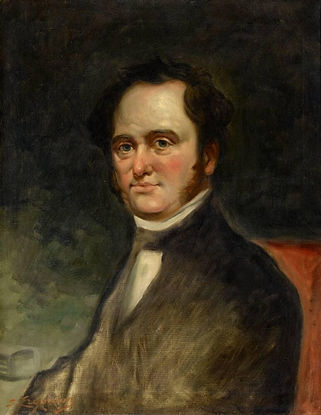
Image Credit - The Museum of Fine Arts Houston
Portrait of Moses Austin
